
Driving high is illegal in all 50 US states, the District of Columbia and Canada, including the states and provinces where cannabis itself is legal, and it can get you a DUI. Cannabis slows reaction time, decision making and coordination, and people who are high are bad at judging how impaired they are.
There is no official safe waiting time. Research suggests most driving skills recover about 5 hours after inhaling 20 milligrams of THC, longer after edibles or bigger doses, and Colorado's health department tells people to wait at least 6 hours after smoking and 8 hours after eating. If you feel different, you drive different.
Contents9
Is driving high illegal?
Yes, everywhere. The National Highway Traffic Safety Administration (NHTSA) puts it simply: driving impaired by any substance, legal or illegal, is against the law in all 50 states and the District of Columbia, and even in states where marijuana laws have changed, it is still illegal to drive under the influence of it. The CDC says the same: driving under the influence of drugs, including cannabis, is dangerous and illegal.
Canada wrote cannabis into the Criminal Code with specific blood levels, covered below, and British Columbia's government adds a line worth keeping: driving under the influence of cannabis is against the law, and there is no standard or safe time to wait before driving after using it.
What weed does to your driving
The CDC lists the effects that matter behind the wheel: cannabis slows your reaction time and your ability to make decisions, impairs coordination, and distorts perception. NHTSA cites research showing it impairs motor skills, lane tracking and cognitive functions, and a 2015 study found THC hurts a driver's ability to multitask.
Does that turn into crashes? The CDC says studies have shown an association between recent cannabis use and car crashes, with more research needed. NHTSA's own crash risk study found marijuana users were more likely to be involved in crashes, with the caveat that part of the increase may come from who uses it (more often young men). The point that matters most is one NHTSA makes bluntly: impaired drivers cannot accurately assess their own impairment. The feeling of "I'm fine, I drive better high" is the impairment talking. NHTSA's slogan sums it up: if you feel different, you drive different.
Can you get a DUI for weed?
Yes. In the US the charge is usually called DUI (Colorado also uses DWAI, driving while ability impaired), based on impairment an officer observes and documents, and some states add a THC blood level that works like a legal limit. Colorado, for example, lets a court assume you were driving under the influence if a blood test shows 5 nanograms per milliliter or more of active delta-9 THC, and it says plainly that officers can arrest you for impaired driving even if you use cannabis medically.
Canada's Criminal Code sets national numbers. Within two hours of driving, it is an offense to have 2 to 5 nanograms of THC per milliliter of blood (a maximum $1,000 fine), a more serious offense to have 5 nanograms or more (mandatory minimums of a $1,000 fine for a first offense, 30 days in jail for a second and 120 days for a third), and an offense to combine 2.5 nanograms of THC with 50 milligrams of alcohol per 100 milliliters of blood. British Columbia's government notes a maximum penalty of ten years in prison, and the province adds an immediate 90-day driving suspension over 5 nanograms and a 12-hour suspension for new drivers with any drug presence at all.
How do police test for weed DUI?
It starts with watching you drive and talking to you. NHTSA says officers are trained to observe driver behavior and identify impairment. From there the tools are the ones Justice Canada lists for Canadian police: the Standardized Field Sobriety Test (walk-and-turn, balance and eye tests), a Drug Recognition Evaluation by a specially trained officer, roadside oral fluid screeners that detect THC in saliva, and a blood test for the actual level.
How long after smoking weed can you drive?
Nobody official will give you one number, and the honest ones say why. Health Canada: there is no standard waiting time to drive after using cannabis, and some effects, such as drowsiness, can last up to 24 hours, well after the high has faded. Its advice is blunt: if you are using cannabis, do not drive.
The research gives a range. A 2021 review of driving and cognitive studies in Neuroscience and Biobehavioral Reviews found that most driving-related skills recover within about 5 hours of inhaling 20 milligrams of THC, that impairment from edibles may take longer to fade, that regular users were less impaired than occasional ones, and it recommended waiting at least 5 hours after smoking or vaping before anything safety-sensitive. Colorado's health department turns that into public guidance with a buffer: wait at least 6 hours after smoking up to 35 milligrams of THC, at least 8 hours after eating or drinking up to 18 milligrams, and longer if you had more. It calls these estimates based on research, not guarantees.
| How you used it | Colorado health guidance | What the 2021 review found |
|---|---|---|
| Smoked or vaped | Wait at least 6 hours (up to 35 mg THC); longer above that | Most skills recover within about 5 hours after 20 mg inhaled |
| Edible or drink | Wait at least 8 hours (up to 18 mg THC); longer above that | Oral THC impairment may take longer to subside |
| Mixed with alcohol | Greater impairment than either alone; do not drive | Not the review's focus; the CDC says multiple substances increase impairment |
Feeling fine is not the test
A strong edible, a dab, or a drink on top of a joint puts you outside every number above, and drowsiness can linger into the next morning. If you have any doubt, you have your answer: get a ride. If you also feel unwell, our too high guide covers what to do, US Poison Control (1-800-222-1222) can help, and mixing with alcohol is its own problem; see crossfaded.
Can you have weed in your car?
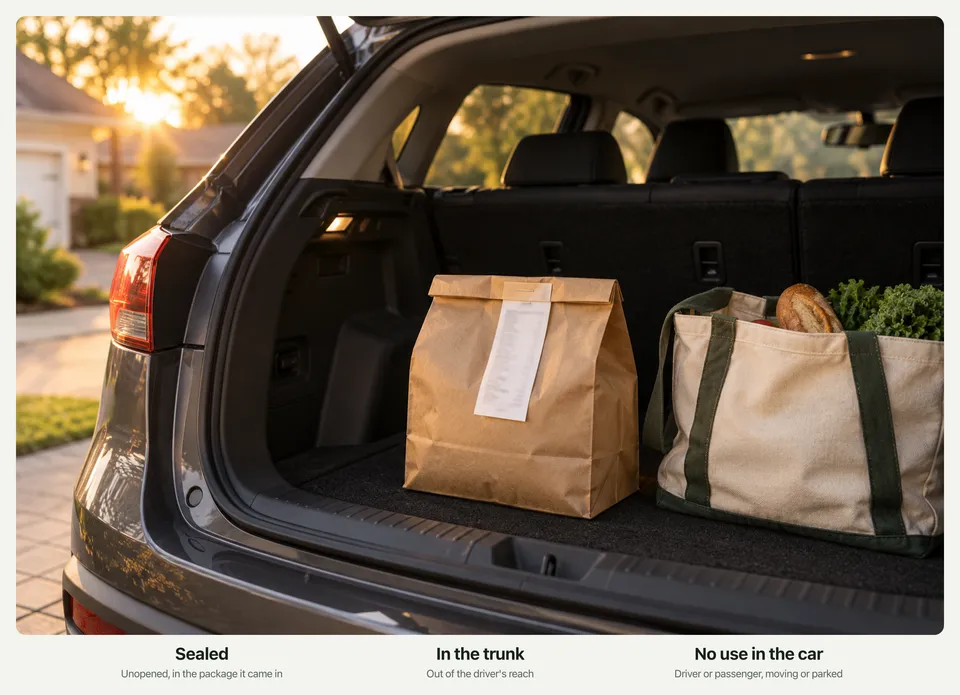
Where cannabis is legal, usually yes, if it is sealed and out of reach; the details are set by each state and province. The pattern in the places we checked is the same as open alcohol. California's Department of Cannabis Control: having an open container of cannabis while driving or riding in a vehicle is illegal. Colorado: neither drivers nor passengers may open any cannabis packaging and use the product in a vehicle, even when it is not moving, and you can be charged if the seal is broken, some is gone, and there is evidence it was used in the car. British Columbia: up to 30 grams in its original unopened packaging, or anywhere the driver cannot reach it, such as the trunk.
So the safe habit is: keep it in the package it came in, unopened, in the trunk, with the receipt if you have one. Opened product goes home, not in the glovebox. And never across a state line or a border; see can you fly with weed for why.
Can a passenger smoke weed in a car?
Not in the places we checked, and do not bet on your state being different. Colorado's open-container rule covers passengers by name. California's covers anyone "driving or riding." British Columbia says it is illegal to consume cannabis as a passenger in a vehicle, and illegal in a parked vehicle on a public road. Two practical problems come with it too. Heavy smoke in a closed space is where non-smokers in a study absorbed enough THC to feel it (see contact high), which is not what a sober driver wants. And the smell stays in the upholstery.
A plan that works
- Pick the driver before anyone uses. NHTSA's first rule for any impairing drug: plan ahead for a sober driver. Rideshare, transit, a friend who is not partaking, or stay where you are.
- Use the longer number. Colorado's guidance is a floor: at least 6 hours after smoking, at least 8 after an edible, and more if you had a lot or still feel anything. Health Canada's version is simpler: if you are using cannabis, do not drive.
- Do not stack alcohol on top. A drink plus cannabis is likely to impair you more than either alone, and in Canada it halves the THC level for the more serious offense.
- Keep the product sealed and in the trunk. Opened packages, used pens and loose flower in the console can turn a traffic stop into a charge.
- If you feel different, you drive different. That is NHTSA's slogan, and it only works one way: feeling normal does not prove you are safe to drive.
Next questions
Common questions
Is driving high a DUI?
Yes. NHTSA says driving impaired by any substance is illegal in all 50 states and DC, even where marijuana is legal, and its own enforcement campaign is called Drive High, Get a DUI. In Canada it is a Criminal Code offense with set THC blood levels.
What is the legal limit for driving high?
In the US there is no single national number; the charge is based on impairment, and some states add a THC level, such as Colorado's 5 nanograms per milliliter of blood. In Canada the limits are 2 nanograms (less serious) and 5 nanograms (more serious) of THC per milliliter of blood, or 2.5 nanograms combined with 50 milligrams of alcohol per 100 milliliters.
How many hours after getting high can you drive?
There is no official safe number. A 2021 research review found most driving skills recover about 5 hours after inhaling 20 milligrams of THC and may take longer after edibles, Colorado's health department says wait at least 6 hours after smoking and 8 after eating, and Health Canada notes drowsiness can last up to 24 hours. When in doubt, do not drive.
How long after you smoke can you get a DUI in Canada?
Canada's blood-level offenses cover the THC in your blood within two hours of driving, and the general impaired-driving offense applies whenever you are impaired. Health Canada says there is no standard waiting time, and some effects, such as drowsiness, can last up to 24 hours.
Can a passenger smoke weed in a car?
No in Colorado, California and British Columbia: all three ban drivers and passengers from using cannabis in a vehicle, and Colorado and British Columbia include parked cars. Other states and provinces have their own versions; assume the answer is no.
Is smoking weed in your car a felony?
In the places we checked, using cannabis in a car is a traffic or open-container offense (Colorado and British Columbia include parked cars), and driving impaired is a crime on its own, with heavier penalties when someone is hurt. Whether a particular charge counts as a felony depends on the state and the circumstances.
Can you get a DUI for weed with a medical card?
Yes. Colorado says officers can arrest you for impaired driving even if cannabis is used medically, and Canada's law has no medical exemption either: the offense is impairment, not the reason you used.
We cite government health agencies and peer-reviewed research. Numbers in the text link to the source.
- Government NHTSA: Drug-Impaired Driving
- Government CDC: Cannabis and Driving
- Peer-reviewed McCartney et al. (2021): Determining the magnitude and duration of acute THC-induced driving and cognitive impairment, a systematic and meta-analytic review, Neuroscience and Biobehavioral Reviews
- Government Department of Justice Canada: Frequently Asked Questions, Drug-Impaired Driving Laws
- Government Government of Canada: Cannabis impairment
- Government Government of British Columbia: Cannabis and driving
- Government Colorado Department of Public Health and Environment: Driving and traveling (cannabis)
- Government California Department of Cannabis Control: What's legal