
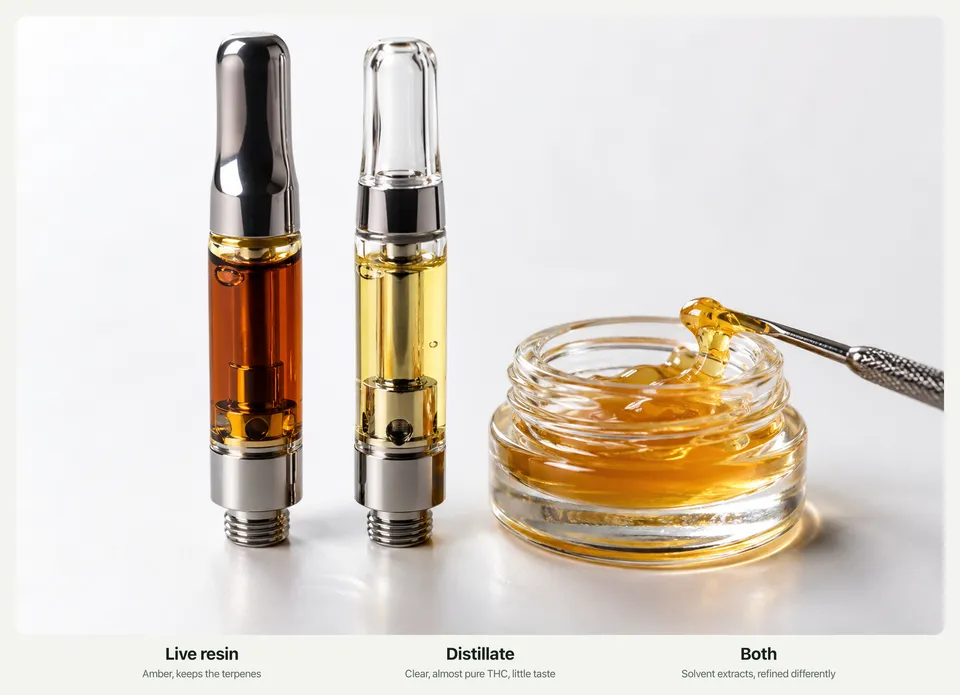
Distillate is cannabis extract refined until it's almost pure THC, with little taste or smell. Live resin, made from fresh-frozen plants, keeps the plant's terpenes, so it tastes like the strain and usually tests lower in THC. Distillate carts can be labeled 85 to 95% THC. Both are solvent extracts; the difference is how far they're refined.
Distillate is the base for many vape carts, infused pre-rolls and gummies. Live resin costs more and is sold for flavor. In a 2020 study of regular users, people using concentrates at 70 and 90% THC felt about as high as people using flower, even with more than twice the THC in their blood. The authors said that does not apply to inexperienced users, so for a beginner a higher number is still a reason to go slower.
Contents10
What is distillate?
Distillate is what's left of a cannabis extract after it's been stripped down to its cannabinoids. Producers start with an extract (made with ethanol, CO2 or a hydrocarbon solvent), filter out the plant waxes and fats, heat it to turn THCA into THC, then distill it: the oil is heated under vacuum so the THC boils off and condenses separately from everything else, sometimes more than once. The result is a clear to golden oil that's thick like honey, with almost no smell or taste. Industry guides put distillate carts at about 85 to 95% THC, and some distillates claim up to 99%.
Because it's so concentrated and so neutral, distillate is the industry's building block. It's in many vape carts, in "infused" pre-rolls, and in a lot of gummies and drinks. For carts, producers add terpenes back, either terpenes captured from cannabis or the same compounds sourced from other plants, which is why a distillate cart can taste like mango or pine.
What is live resin?
Live resin skips the drying and curing that normal flower goes through. The plant is frozen right after harvest, then extracted with butane or propane in a closed system. Freezing keeps the terpenes that drying would lose, so the extract smells and tastes strongly of the plant it came from. It's sold as dabs (sauce, badder, sugar, diamonds) and in carts. The live resin vs. live rosin page covers how it's made and tested in detail.
Live resin vs. distillate, side by side
| Distillate | Live resin | |
|---|---|---|
| How it's made | Extracted, filtered, heated, then distilled until nearly pure THC | Fresh-frozen plant, solvent-extracted, lightly purged; not distilled |
| THC on the label | Often 85% or more | Usually lower; varies by batch |
| Terpenes | Removed, then added back for carts | The plant's own, kept |
| Taste and smell | Neutral, or whatever terpenes were added | Like the strain |
| Looks | Clear to gold, thick, uniform | Golden to amber, often with crystals or a grainy texture |
| Price | Usually lower | Usually higher |
| Where you'll see it | Most carts, infused pre-rolls, gummies, drinks | Dabs, premium carts |
Which gets you higher?
The label says distillate. The evidence says it's not that simple. In a 2020 study published in JAMA Psychiatry, researchers in Colorado had 121 regular users buy an assigned legal product and use it at home: flower at 16 or 24% THC, or concentrates at 70 or 90%. The concentrate group's blood THC peaked at more than twice the flower group's, yet both groups reported similar highs and showed similar changes on balance and memory tests. Potency on the label didn't track with how high people felt. Those were regular users who have learned to adjust how much they take, and the authors cautioned that the result does not apply to inexperienced users, who should be extremely cautious with concentrates. The study also didn't compare live resin with distillate; it compared concentrates in general with flower. For a new user, a 90% product is still a lot of THC in one breath.
You'll also hear that live resin at 70% "hits harder" than distillate at 95% because of the terpenes. That's the entourage effect, and it's a hypothesis, not a measured result; the entourage effect page goes through what's actually been tested. What people reliably notice is flavor and smell. The high comes from the THC in both.
Flavor, and what "added terpenes" means
Live resin tastes like the plant because the plant's own aroma compounds survived the process. Distillate tastes like nothing, so cart makers blend terpenes back in. "Cannabis-derived terpenes" were captured from cannabis, sometimes from the same strain. "Botanical terpenes" are the same molecules from other plants: limonene from citrus, pinene from pine. Many of the main molecules are the same, though not always an exact match, and the cannabis-derived blend tends to be more complex because it carries many minor compounds along. Either way, a cart's smell is terpenes, and a strain name on a distillate cart describes the flavor blend, not the oil.
Which is safer?
Neither is "clean," and the gap between them is smaller than the gap between licensed and unlicensed products. Both start as solvent extracts. In licensed markets such as California, each batch is lab-tested for leftover solvent before it can be sold. In the vaping lung-injury outbreak the CDC investigated in 2019, an additive called vitamin E acetate was strongly linked to the illnesses, and most cases involved THC carts from informal sources such as friends or dealers. The CDC said other chemicals couldn't be ruled out. So the safety question is where the cart came from and what was added to it. The vapes guide covers how to spot fake and illegal carts and what's in a real one.
Both are extracts
Health Canada tells new and occasional users to avoid extracts because of their THC concentration, and that covers distillate and live resin alike. If you're new and you've chosen a cart anyway, the vapes guide explains how carts deliver THC and how to start low. Health Canada notes it can take up to 30 minutes to feel the full effects of an inhaled product, so wait before taking more. If you overdo it, the too high page tells you what to do.
Which should a beginner pick?
- If you want flavor, live resin. It costs more and the label number is lower, which for a beginner is not a downside.
- If you want consistent and cheaper, distillate. The high is THC-forward and the taste is whatever terpenes were added.
- Either way, buy from a licensed store, check for a test result, and treat the THC percent as a reason to take less, not more.
- If you'd rather not inhale a concentrate at all, lower-THC flower is the usual gentler start. A low-dose edible is another, but edibles take much longer to kick in. See first time? Start here.
Live resin vs. distillate vs. rosin
Rosin is the third name on the menu. It's pressed out of flower or hash with heat and pressure, no solvent at all, and it's never distilled, so it keeps its terpenes like live resin does. Live rosin is rosin pressed from hash made from fresh-frozen plants. On a cart shelf you'll see all three: distillate (cheapest, most THC on the label), live resin (plant flavor, solvent-made), live rosin (plant flavor, solventless, usually the most expensive). The live resin vs. live rosin page compares those two.
Words you'll hear
- Distillate, "disty": refined THC oil.
- Full spectrum: an extract that keeps the plant's range of compounds; live resin and rosin are sold this way. Distillate is the opposite.
- Cannabis-derived terpenes (CDT), botanical terpenes: what was added back to a distillate cart, and where it came from.
- Liquid diamonds: THCA crystals melted into live resin sauce, sold in carts as a high-THC, high-flavor middle ground.
- Winterization: the cold-filtering step that pulls waxes out of an extract before distilling.
- Cutting agent: anything added to thin an oil. Licensed carts list ingredients; the CDC strongly linked vitamin E acetate to the 2019 outbreak.
Common questions
What will get me higher, live resin or distillate?
Distillate carries more THC per puff on paper, often 85 to 95% on the label. But a 2020 study found regular users of 70 and 90% concentrates felt about as high as flower users despite more than twice the blood THC, and the authors said that does not apply to inexperienced users. For a new user, both are strong; the label number is a reason to take less.
Does live resin actually get you higher?
Not by THC content; it usually tests lower than distillate. People who say it hits harder are describing flavor and the full mix of plant compounds, which is the entourage effect, an idea that hasn't been proven in trials. The high comes from THC in both.
Does distillate get you higher?
On paper, yes: it usually carries the highest THC number, so each puff has more THC. In one study of regular users, higher potency didn't track with how high people felt, but for a beginner more THC per puff is still a reason to go slower.
Does live resin smell worse than distillate?
It smells more. Live resin keeps the plant's terpenes, so the vapor smells like cannabis. Distillate carts smell of whatever terpenes were added, often lighter or fruitier. Vapor from either usually fades faster than smoke.
What is a distillate cart?
A vape cartridge filled with distillate plus added terpenes for flavor. It's the most common and usually the cheapest kind of cart. Licensed ones list ingredients and a lab result; the vapes guide explains what to check.
Is live resin better than distillate?
Better at flavor, not better at getting you high. Live resin keeps the plant's taste and costs more; distillate is neutral, cheaper and tests higher. Pick by what you want from it, and buy licensed either way.
Is distillate safe?
In licensed markets such as California, distillate is lab-tested for leftover solvent and sold with an ingredient list. The CDC strongly linked the 2019 vaping lung-injury outbreak to vitamin E acetate, an additive in THC carts mostly bought from informal sources. Health Canada still tells new users to avoid extracts of any kind because of the THC concentration.
We cite government health agencies and peer-reviewed research. Numbers in the text link to the source.
- Government Health Canada: Cannabis, lower your risks (extracts, timing)
- Government California Code of Regulations, 4 CCR 15718: Residual solvents and processing chemicals testing
- CU Boulder Today on Bidwell et al. (2020), JAMA Psychiatry: concentrates raise blood THC but not impairment
- Government CDC: Outbreak of lung injury associated with e-cigarette or vaping products (vitamin E acetate)
- Technology Networks (2022): Cannabis distillate, what it is and how it's made
- Weedmaps: Live resin carts vs distillate carts (terpenes added back, THC ranges, price)