
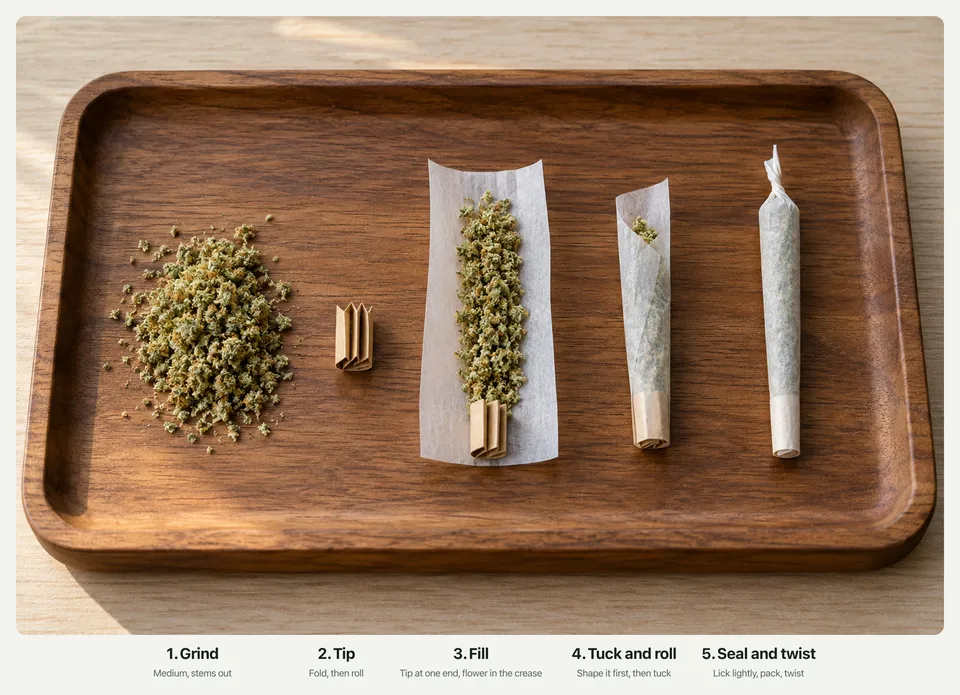
To roll a joint, lay ground flower and a small cardboard tip in a rolling paper, shape it into an even tube, then tuck, roll, lick to seal and twist the open end closed. It takes most people a few tries to get a joint that burns evenly.
Beginner guides usually suggest the standard 1 1/4 paper and a small amount of flower. A small joint is easier to roll, and you don't have to finish it. Start low, go slow. Few people roll a good joint on the first attempt. Expect to re-roll.
Contents10
What you need
- Rolling papers. Thin, unflavored papers are easiest to taste through. Sizes below.
- Something to make a tip. Thin cardboard, a business card, or a pack of pre-rolled tips.
- A grinder, or clean fingers and patience.
- Flower. Dried, not damp and not bone-dry. Pull the stems out first.
- A flat surface or tray to catch what falls.
| Paper size | About | Who uses it |
|---|---|---|
| Single wide | 68 to 70 mm long, narrow | Thin joints. Fiddly for new hands. |
| 1 1/4 | 76 to 78 mm long, about 44 mm wide | The standard. Guides for beginners recommend starting here. |
| 1 1/2 | Same length, wider | Fatter joints for sharing. |
| King size | About 110 mm | Long joints for groups. Harder to roll evenly. |
Store pre-rolls usually hold half a gram or a full gram. Rolling guides for beginners often suggest about half a gram in a 1 1/4 paper, mostly because a smaller joint is easier to roll. You don't have to smoke all of it. Start low, go slow. The weed measurements guide explains what those numbers look like.
Step 1: make the tip
A tip (also called a crutch or filter) is a small roll of cardboard at the mouth end. It keeps flower out of your mouth, gives the joint a firm shape, and lets you smoke it to the end without burning your fingers. It doesn't filter the smoke.
- Cut a strip. Thin cardboard, about half an inch wide and two inches long.
- Fold one end like an accordion. Fold the first bit back and forth two or three times.
- Roll the rest around the folds. The folds stay in the middle and stop flower passing through.
Step 2: fill and shape
- Grind the flower. Medium is right. Powder packs too tight and won't pull; chunks leave gaps and burn unevenly.
- Hold the paper in a shallow U. Glue strip on top, facing you, cupped between your thumbs and fingers.
- Put the tip at one end. Line it up flush with the edge of the paper.
- Sprinkle the flower along the crease. A little less than you think. Leave the tip end slightly thinner so the joint tapers like a cone.
- Shape it. Roll the paper back and forth between your thumbs and fingers so the flower packs into an even tube. This is the step that decides whether it burns well. Take your time.
Step 3: tuck, roll and seal
- Tuck the near edge. That's the edge without glue. Tuck it under the flower, starting at the tip end, where the paper has something firm to wrap around.
- Roll it up. Use your thumbs and keep the tuck tight until only the glue strip is showing.
- Lick the glue lightly. Press it down from the tip end outward. Too much spit soaks the paper and it tears.
Step 4: pack and twist
- Tap the open end. Use a pen or a thin stick so the flower settles. Add a pinch if there's a gap.
- Twist the open end closed. That's the end you light.
How to light a joint and smoke it
- Toast the tip first. Hold the flame near the twisted end and turn the joint so the whole tip catches before you pull. Lighting one side only is a common cause of canoeing.
- Small, slow puffs. Big pulls make it burn hot and harsh.
- Don't hold the smoke in. Two small lab studies disagree about whether holding it makes the high stronger. One found no consistent effect on mood, and the other found higher "high" ratings. The first also measured carbon monoxide: a 20-second hold put more of it into the body than no hold. Public-health guidelines say to skip breath-holding because it raises the toxic material you take in.
- Wait before you have more. Smoked cannabis is felt within seconds to minutes, and the effects keep building for a while. If you're new, the first-time guide walks through the timing.
- Ash it, don't tap it to death. Let a little ash build; it helps it burn evenly. If it goes out, relight the end.
Smoke is smoke
The CDC says cannabis smoke carries many of the same toxins and cancer-causing chemicals as tobacco smoke, and that smoking it raises the risk of bronchitis, cough and mucus. A joint is the simplest way to smoke, not a safer one. If you want to avoid smoke, edibles and vaporizers exist; the vapes guide covers the trade-offs. And if you overdo it, the too high page tells you what to do.
Why your joint canoes, won't pull, or falls apart
- It burns down one side (canoeing). Uneven packing or uneven lighting. Next time, shape longer before you tuck and toast the whole tip. Mid-smoke, a little spit on the fast-burning side slows it down.
- It won't pull. Packed too tight, or the grind was too fine. Loosen the next one; roll the paper with less force.
- It burns in a minute. Too loose. More shaping before the tuck, and a firmer pack at the end.
- The paper tore. Too much lick, or the paper was too thin for your hands. Try a slightly thicker paper until the motion is familiar.
- Flower keeps falling out of the end. You skipped the twist.
How to roll a joint without a filter (or papers)
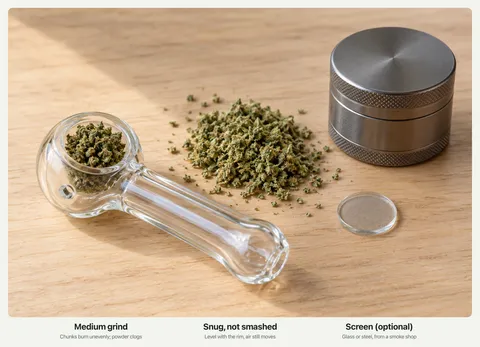
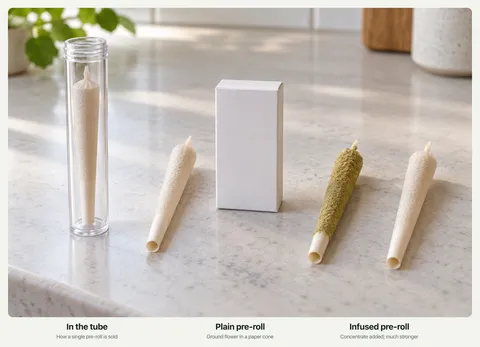
Without a filter tip: the joint still works. The end just gets soggy and hot, and you'll throw the last bit away. Without papers: you need a pipe or a bong instead; the bowl guide covers that. Without skill: buy pre-rolled cones. You fill them with a pen and tap them down. Most stores sell empty cones next to the papers, and a pre-roll from the counter skips the whole job.
Words you'll hear
- Tip, crutch, filter: the cardboard mouthpiece. It isn't a real filter.
- Cone: a joint that tapers from the tip to a fat end; also the pre-rolled empty papers shaped that way.
- Pinner: a thin joint.
- Canoe: burning down one side.
- Roach: the last bit of a joint.
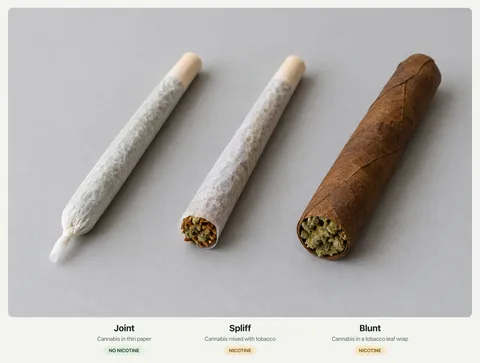
- Spliff, blunt: a joint with tobacco mixed in, and a joint rolled in a tobacco-leaf wrap. See joint vs. blunt vs. spliff.
Common questions
How do you roll a joint easily?
Use 1 1/4 papers, a cardboard tip, a medium grind and less flower than you think. Spend most of your time shaping the flower into an even tube before you tuck. If that still fails, buy pre-rolled cones and fill them.
How should a rolled joint look?
Even and firm, like a pencil or a slim cone, with no lumps or loose gaps, the tip flush with the paper and the far end twisted shut. Light should not show through thin spots.
Which end of a joint do you light?
The twisted end. The cardboard tip goes in your mouth, and the far end, the one you twisted shut, gets the flame. Toast the whole twisted tip before you pull so it catches evenly and is less likely to canoe.
What is the correct way to smoke a joint?
Toast the whole tip before you pull and take small, slow puffs. Don't hold the smoke in. Studies disagree on whether holding makes the high stronger, and public-health guidelines say it adds to the toxic material you take in. Wait a while before having more.
How do you roll a joint without a filter?
The same way, with nothing at the mouth end. It works; the last inch gets hot and soggy, so people put it out and toss the roach. A rolled-up bit of cardboard fixes that and takes ten seconds.
How much weed goes in a joint?
Store pre-rolls usually hold half a gram or a full gram. Rolling guides often suggest about half a gram in a 1 1/4 paper for a first roll, and thin joints hold less. Those are common sizes, not a dose. Start low, go slow, and wait between puffs.
Why does my joint keep canoeing?
Uneven packing or lighting one side. Shape the flower longer before tucking, toast the entire tip before the first pull, and turn the joint as you light it.
How do I pack a joint correctly for rolling?
Grind the flower to a medium texture and spread it evenly along the crease, a little thinner at the tip end. Shape it into a firm, even tube before you tuck. After sealing, tap the open end with a pen so it settles, then twist it shut.
We cite government health agencies and peer-reviewed research. Numbers in the text link to the source.
- Peer-reviewed Fischer et al. (2017): Lower-Risk Cannabis Use Guidelines, American Journal of Public Health (avoid deep inhalation and breath-holding)
- Peer-reviewed Zacny and Chait (1991): Response to marijuana as a function of potency and breathhold duration, Psychopharmacology
- Peer-reviewed Block et al. (1998): Sedative, stimulant, and other subjective effects of marijuana: relationships to smoking techniques, Pharmacology Biochemistry and Behavior
- Government CDC: Cannabis and lung health
- Leafly: How to roll a joint (beginner paper size and amount)
- Weedmaps: How to roll a joint (joint sizes, crutch, common mistakes)