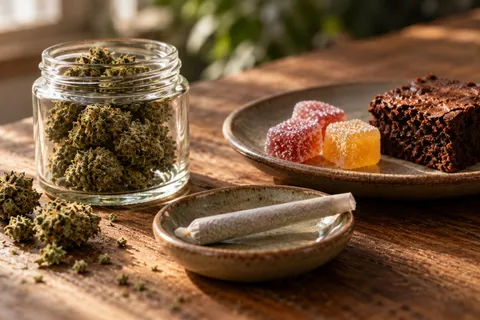

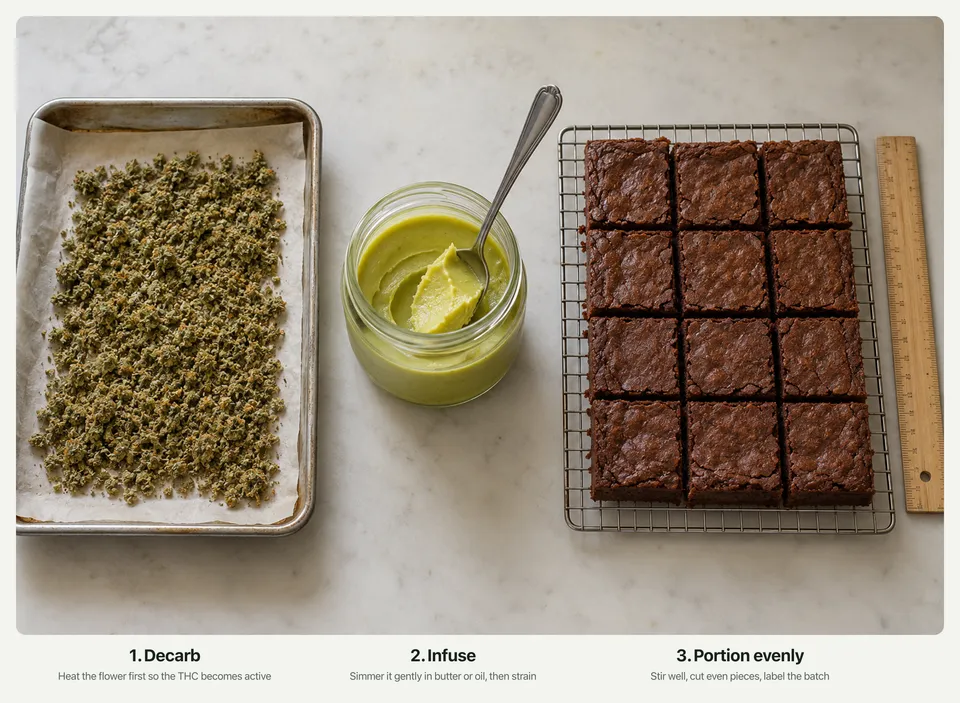
To make edibles, heat ground flower in the oven to activate the THC, simmer it gently in butter or oil so the THC moves into the fat, strain it, then cook with that butter like any other butter. The heating step is called decarboxylation, or decarb.
Homemade edibles are easy to make and easy to make too strong. Work out the strength before you bake, portion evenly, label the batch, and treat the first piece as a test: eat a small amount and wait at least 2 hours.
Contents8
What you need
- Flower with a THC percent on the label. Many people keep a first batch small, an eighth (3.5 grams) or less.
- A grinder or scissors, a baking sheet, parchment or foil, and an oven.
- Butter or coconut oil, a small pot or slow cooker, a thermometer if you have one.
- Cheesecloth or a fine strainer, a jar for the finished butter, and a label.
- The edible dosage calculator, so you know roughly what you made.
Step 1: how to decarb weed in the oven
Raw flower holds most of its THC as THCA, which needs heat to become THC. That's why eating raw flower does nothing and why edibles need this step. In one lab study, cannabis extract heated in an airless lab oven finished the change in about 30 minutes at 230 F (110 C). It was faster when hotter: about 9 minutes at 266 F (130 C). Flower in a home oven heats less evenly. A widely used home guide says 245 F for 30 to 40 minutes.
- Preheat to 240 F (115 C).Ovens run hot or cold. If yours has a thermometer, trust the thermometer.
- Break the flower into small pieces.Coarse, not powder. Spread it in one layer on parchment on a baking sheet.
- Bake for 30 to 40 minutes.Stir once halfway. It's done when it looks light brown and smells toasted. It will smell strongly, so open a window.
- Let it cool.Then it's ready to infuse or to grind finer.
Higher temperatures don't make it stronger. They burn off the compounds that give flower its smell and flavor. Lab studies have also seen THC break down or evaporate at about 290 to 320 F (145 to 160 C).
Step 2: infuse butter or oil
Once you decarb weed for butter, the THC needs fat to move into. It dissolves into fat, not water. Butter and coconut oil are the usual choices. Home recipes often call for 7 to 10 grams of flower per cup of butter (two sticks). That makes strong butter: a pan of brownies from it can come out several times stronger than a store edible. Less flower makes a milder batch, and the calculator shows what your amounts mean per piece.
- Melt the butter with a cup of water.The water keeps the butter from scorching and is easy to separate later.
- Add the decarbed flower and keep it low.Aim for a gentle simmer, about 160 to 200 F (70 to 93 C). Never let it boil. Two to three hours is the usual range, stirring now and then. Longer doesn't seem to add much. In one magazine's test with two cannabis labs, four extra hours added almost no THC.
- Strain through cheesecloth.Don't squeeze hard. Squeezing pushes plant matter and bitter chlorophyll through.
- Chill, then lift the butter off the water.Pour off the water, pat the butter dry, and store it in a labeled jar in the fridge.
Step 3: figure out how strong it is
This is where most homemade edibles go wrong. A gram of flower at 20% THC holds about 200 mg of THC. If the label shows THCA, heating turns it into THC with a loss of about 12% by weight. A "Total THC" number already includes that loss. Then butter only picks up part of what's there. People who test edibles often put it at about 30 to 60%, and yours may be higher or lower. Nobody can know their own number without a lab.
So the honest answer is a range. Type your flower, the label percent, and your pieces into the edible dosage calculator and it gives you a low-to-high estimate per piece. Then compare it with how store edibles are labeled: Health Canada tells new users to look for 2.5 mg or less, and many US states cap a serving at 10 mg. If your pieces come out far above that, make them smaller or dilute the butter with plain butter.
Step 4: bake and portion evenly
- Stir the butter and the batter well. Cannabinoids can settle in melted butter, so an unstirred batch can be stronger in one spot than another.
- Cut with a ruler. Even pieces are the only way the number per piece means anything.
- Label the container. Date, what's in it, pieces per batch, estimated mg per piece. Future you will thank you.
Step 5: test one piece and wait
Eat a small piece, or half of one, and wait at least 2 hours before deciding anything. Edibles can take up to 2 hours to start and up to 4 hours to reach full effect. That's why people overdo them: they feel nothing at 45 minutes and eat another. The edible timing guide walks through the clock. Start low, go slow. You can always have more later. You can never have less.
Homemade edibles are the easy way to get too high
They look like food, they take hours to show up, and the strength is a guess. Keep them locked away from children, pets and anyone who doesn't know what they are. Never serve one to someone without telling them. If someone takes too much, the too high page tells you what to do. If a child eats one, call Poison Control at 1-800-222-1222 right away, or 911 if they are hard to wake or have trouble breathing. If a pet eats one, call your vet or Poison Control.
Common mistakes
- Skipping decarb. Much of the THC stays as THCA, so the butter comes out weaker and harder to predict.
- Too much flower. Some recipes call for far more flower than a beginner needs. Run your numbers through the calculator first.
- Boiling the butter. High heat burns off flavor and some THC. Keep it at a gentle simmer.
- Eating a second piece at the one-hour mark. The first one hasn't arrived yet.
- No label. Infused food in an unmarked container is how accidents happen.
Common questions
Is making your own edibles worth it?
It can be cheaper, and you control the ingredients. The trade-off is that you won't know the exact strength, so you have to portion carefully and test. If you want a precise, labeled dose, store-bought edibles are the simpler choice.
Can you make edibles out of buds?
Yes. Ground, decarbed buds infused into butter or oil are the classic way. Trim (the small leaves cut off buds) and shake (the loose bits at the bottom of a bag) work too. They're weaker per gram, so the math changes.
What is the quickest way to make an edible?
Decarb the flower (30 to 40 minutes), then infuse it into a small amount of coconut oil or butter and use that in a no-bake recipe. There's no safe shortcut around the decarb and infusion time, and the wait after eating is still up to 2 hours.
How do they make edibles in a dispensary?
Licensed makers use lab-tested cannabis extract or distillate, mix it in measured amounts, and test the finished product so each piece carries a labeled milligram count. That testing is what homemade batches don't have.
How long do you decarb weed?
A widely used home guide says 30 to 40 minutes at 245 F (118 C). In a lab study of cannabis extract, the change was complete in about 30 minutes at 230 F. Hotter is faster but burns off flavor.
Can you make edibles without decarbing?
You can, but they come out weaker and harder to predict. Raw flower holds THCA, which needs heat to become THC. Simmering and baking convert some of it, not all, so decarb first.
How strong will my edibles be?
Stronger than you'd guess, and impossible to know exactly. Use the calculator for a range, then test a small piece and wait at least 2 hours before deciding anything.
How should I store homemade edibles?
Labeled, sealed, and locked away from children and pets. Infused butter keeps in the fridge for a few weeks and in the freezer for months. Baked goods spoil like any food.
We cite government health agencies and peer-reviewed research. Numbers in the text link to the source.
- Peer-reviewed Cannabis and Cannabinoid Research (2016): Decarboxylation study of acidic cannabinoids
- Government Health Canada: Cannabis, lower your risks
- Government CDC: Cannabis FAQs
- Government Montana Department of Revenue, Cannabis Control Division: Concentrate facts 101 (start low and go slow; lock products away)
- Government California Code of Regulations, 4 CCR 17304: THC limits for edibles
- Leafly: How to make cannabutter (home method, temperatures and ratios)