
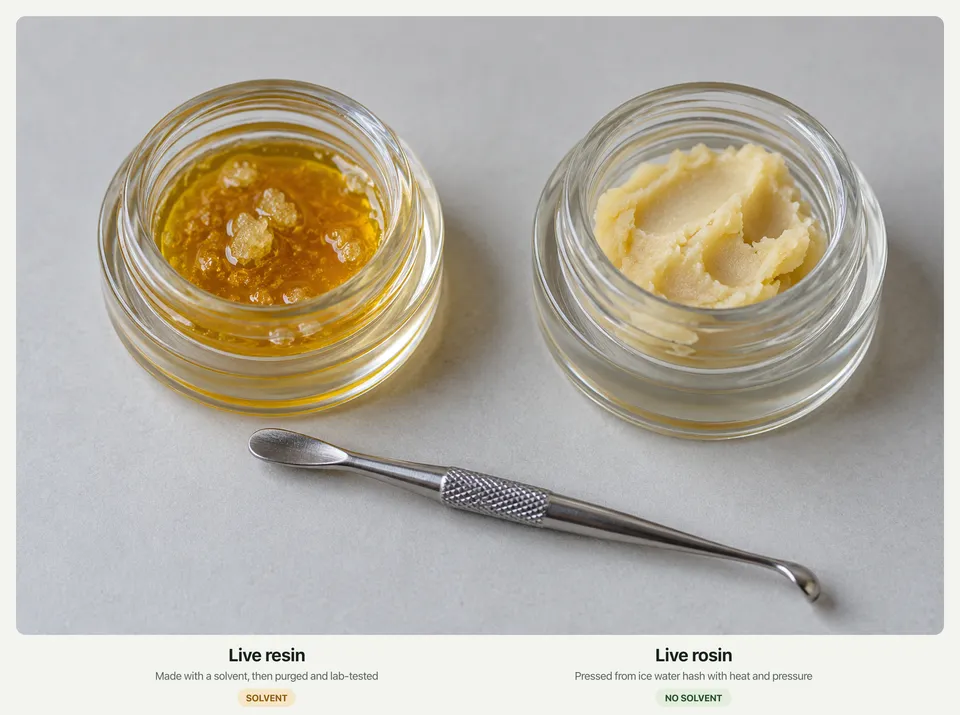
Live resin and live rosin both start with cannabis that was frozen fresh at harvest, but live resin is extracted with a solvent such as butane, while live rosin is pressed out with nothing but ice water, heat and pressure. "Live" means the plant was never dried. "Rosin" means no solvent.
Both are concentrates. One state regulator's guide puts concentrates at about 50 to 98% THC, against about 12 to 30% for flower. Neither is a first product. Health Canada tells new and occasional users to avoid extracts, and if you're new, start with flower or a low-dose edible.
Contents10
What is live resin?
Live resin is a cannabis concentrate made from plants that were frozen right after harvest instead of being dried and cured. The frozen plant goes through a closed machine. Inside, a solvent, usually butane or propane, pulls the THC and the aroma compounds called terpenes out of the plant. The solvent is then evaporated off, or "purged," leaving a sticky, golden extract. Freezing the plant first keeps more of the terpenes, which is why live resin smells and tastes much more like the fresh plant than older concentrates do.
You'll see live resin sold as a dab (sauce, badder, sugar, diamonds) and inside vape carts, which is where most people first see the name.
What is rosin, and what is live rosin?
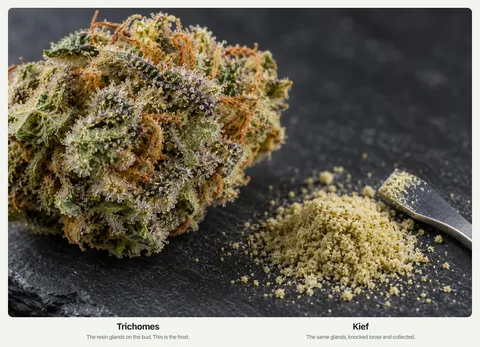
Rosin is cannabis oil pressed out with heat and pressure, with no solvent. Live rosin starts the same way as live resin, with fresh-frozen plants, but no solvent ever touches it. First the frozen flower is stirred in ice water, which knocks the trichomes (the tiny resin glands) off the plant. The trichomes are collected through fine mesh bags and dried into "ice water hash." Then the hash is squeezed between heated plates. The oil that presses out is live rosin.
That's the whole process: ice, water, mesh, heat and pressure. It takes more work and more flower per gram than solvent extraction, which is why live rosin usually costs more and is harder to find.
What does "live" mean, and what is cured resin?
"Live" means the plant was frozen fresh and never dried. "Cured" means the flower was dried and cured first, the way flower you smoke is. Terpenes fade during drying, so live products keep more smell and flavor than cured ones. Cured resin and plain rosin (pressed from dried flower or dried hash) are the same products made from dried material.
So the names stack up like this: resin or rosin tells you how it was made. Live or cured tells you what it was made from.
Rosin vs. resin, side by side
| Feature | Live resin | Live rosin |
|---|---|---|
| Starts with | Fresh-frozen cannabis | Fresh-frozen cannabis |
| How it's made | A solvent like butane dissolves the oils, then is purged off | Ice water hash is pressed between heated plates |
| Solvent | Yes, mostly removed, then lab-tested in licensed markets | None |
| Looks like | Golden sauce, sugar, badder or diamonds | Pale, creamy or honey-colored, often called "fresh press" or "cold cure" |
| Flavor | Strong, close to the fresh plant | Strong, often described as the closest to the plant |
| Strength | Concentrate range; check the label | Concentrate range; check the label |
| Price | Usually less, because it's faster to make | Usually more, because it's slower and yields less |
| Where you'll see it | Dabs and vape carts, widely available | Dabs and some carts, fewer stores |
Does live rosin get you higher than live resin?
Not by default. Both land in the same concentrate range, and the number that matters is the THC percent on the label of the jar in your hand. A live rosin at 65% is weaker than a live resin at 85%, and the other way around.
When people say rosin feels different, they usually mean the flavor, not more THC. For a beginner the important comparison isn't resin versus rosin. It's that any concentrate is several times stronger than flower. A regulator's consumer guide puts concentrates at 50 to 98% THC and flower at 12 to 30%.
Is rosin better for your lungs than resin?
The honest answer has three parts.
- Leftover solvent is tested for. In licensed markets such as California, each batch is lab-tested for leftover solvent, and a batch that fails can't be released for sale. California's limit for butane is 5,000 micrograms per gram. Rosin skips that question entirely because no solvent was used.
- Heat is the bigger issue. Dabbing means vaporizing a concentrate on a very hot surface. In one lab study, heating the terpenes found in cannabis at common dabbing temperatures made an irritating chemical called methacrolein. At the hottest setting it also made benzene, which can cause cancer. At the lowest temperature tested, no methacrolein was found. Rosin and resin both contain terpenes, so this applies to both.
- The dose is the real risk. Dabbing can deliver a large amount of THC very fast, which raises the chance of a bad reaction. That's the US government's warning, and it's the one that matters most for someone new.
No inhaled product is risk-free. "Solventless" is a real difference in how it's made, not a free pass for your lungs.
Live resin vs. distillate
Distillate is the third word you'll see on the vape cart shelf. It's cannabis oil refined down to almost pure THC, which strips out the terpenes. Makers then add flavor back, sometimes with cannabis terpenes and sometimes with other plant terpenes. Distillate carts are usually the cheapest and the most consistent. Live resin carts usually cost more and taste more like the plant. Live rosin carts are the rarest and usually the priciest. All three can be very strong, so the label, not the name, tells you what you're getting. The vape carts guide covers how carts work.
Which should a beginner pick?
For a first time, neither. Regulators and health agencies agree on this one. Health Canada tells new users to avoid cannabis extracts because the higher THC raises the risk of a bad reaction. Montana's cannabis regulator says concentrates are for experienced consumers with a higher tolerance. Start with flower or a low-dose edible, learn how cannabis feels for you, and come back to concentrates later if you're curious.
If you do try a concentrate
Start low, go slow: use the smallest amount you can, such as one short puff of a cart, with someone experienced nearby. Then wait, because full effects can take up to 30 minutes. If your device lets you set a temperature, lower is gentler. Concentrate rigs get extremely hot, so mind your hands. If you end up too high, that page walks you through it, and Poison Control is free at 1-800-222-1222 any time.
When you're ready to choose between the two: pick live rosin if flavor and "no solvent" matter to you and you don't mind paying more. Pick live resin if you want the same fresh-plant taste at a lower price and more choice on the shelf. Either way, read the THC percent.
Words you'll hear
- Dab: a small amount of concentrate vaporized on a hot surface, usually with a "rig."
- BHO: butane hash oil, the family most live resin belongs to.
- Hash rosin: rosin pressed from ice water hash. Most live rosin is hash rosin made from fresh-frozen plants.
- Flower rosin: rosin pressed straight from dried buds. Simpler, and usually seen as a step below hash rosin.
- Fresh press, cold cure: rosin styles. Fresh press is sold soon after pressing. Cold cure is kept cool for a while after pressing, until it turns creamy.
- Sauce, sugar, badder, diamonds, shatter: textures of solvent-made concentrates like live resin, from runny to crystals to glass. Diamonds are mostly crystals of THCA, the form THC takes before it's heated. The label, not the texture, tells you the strength.
- Solventless: made without any solvent. Rosin and ice water hash are solventless. Live resin is not.
Common questions
Is rosin the same as resin?
No. Resin, in cannabis, means a concentrate made with a solvent such as butane. Rosin is made with heat and pressure only. "Live" in front of either word means the plant was frozen fresh instead of dried.
Does resin get you higher than rosin?
Not as a rule. Both sit in the same concentrate range, and the THC percent on the label decides. What's true is that any concentrate is several times stronger than flower.
Is rosin better for your lungs than resin?
Rosin has no solvent to leave behind. In licensed markets such as California, live resin is lab-tested for leftover solvent and can't be sold if it fails. For your lungs, the bigger factors are how hot you heat it and how much THC you take in at once. No inhaled product is risk-free.
Is live rosin the most potent concentrate?
Usually not. Live rosin is prized for flavor more than for the highest THC. Distillate is refined to be mostly THC, so it often tests higher. Check the label for the number.
Does live rosin get you really high?
It can. It's a concentrate, and one state regulator puts concentrates at about 50 to 98% THC, against about 12 to 30% for flower. A small amount goes a long way, which is why new users are told to avoid extracts.
What does "live" mean in live resin?
The plant was frozen right after harvest and never dried or cured. That keeps more of the terpenes, the compounds behind the smell and flavor. "Cured" products are made from dried flower.
Why is live rosin more expensive?
It's slower to make and uses more flower per gram. Ice water hash has to be washed, sifted, dried and pressed, which takes more hands-on work, while solvent extraction runs in larger batches. Fewer makers offer it, too.
What is hash rosin?
Rosin pressed from ice water hash rather than from whole buds. Most high-end rosin is hash rosin, and live rosin is hash rosin made from fresh-frozen plants.
We cite government health agencies and peer-reviewed research. Numbers in the text link to the source.
- Government NIDA (NIH): Cannabis (marijuana), concentrates and dabbing
- Government Montana Department of Revenue, Cannabis Control Division: Concentrate facts 101
- Government Health Canada: Cannabis, lower your risks
- Government California Code of Regulations, 4 CCR 15718: Residual solvents and processing chemicals testing
- Peer-reviewed ACS Omega (2017): Toxicant formation in dabbing, the terpene story
- Leafly glossary: Live resin