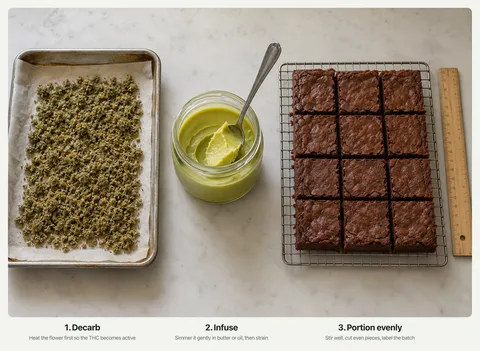

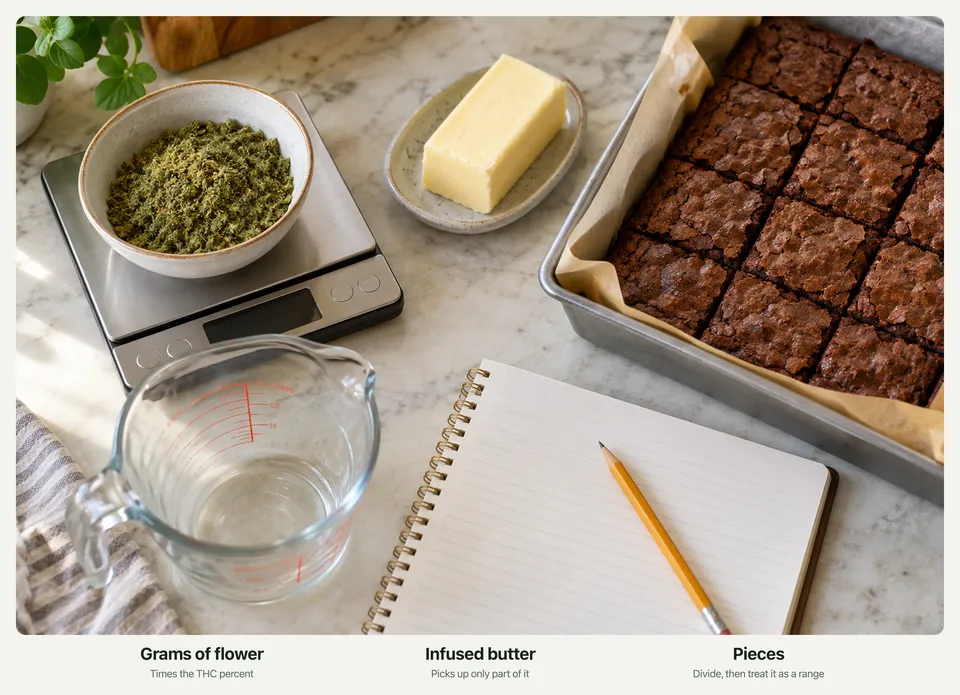
To estimate the THC in a homemade edible, multiply the grams of flower by the THC percent on the label, times 10, then by the share your butter or oil actually picked up, and divide by the number of pieces. One gram of flower at 25% THC holds about 250 mg of THC before any of it is lost.
The calculator below does that math and shows a low-to-high range, because home infusions lose a lot of THC and nobody can measure it without a lab. Treat it as a rough guess. The real number can be higher or lower.
Contents6
Edible calculator
Estimate the THC in homemade edibles from the flower, the butter or oil, and the number of pieces.
Butter and oil only pick up part of the THC; estimates range from about 30 to 60 percent, and some go higher; the slider allows 30 to 90.
About 26 mg a piece (likely 20 to 33). The real number can be higher.
All the butter or oil holds about 420 mg of THC (likely 315 to 525 mg).
For reference: many US states cap a store-bought serving at 10 mg. Health Canada caps a Canadian package at 10 mg and tells new users to look for 2.5 mg or less per product.
An estimate. Home infusions vary a lot. Test a small piece and wait at least 2 hours before deciding anything. See how long edibles take and what to do if you get too high.
How to calculate edible dosage
- Turn the label percent into milligrams.A gram is 1,000 milligrams, so a gram of flower at 20% THC holds 200 mg of THC. A state regulator's consumer guide uses the same math: 1 gram at 25% is 250 mg.
- Check whether the label says THC or THCA.Raw flower holds its THC mostly as THCA, which only becomes THC when it's heated. Each milligram of THCA becomes about 0.88 mg of THC, because the molecule loses weight in the change. If your label shows "Total THC," the loss is already counted, so nothing comes off; California, for example, requires flower labels to show Total THC. If it shows only THCA, the calculator takes that 12% off. If it lists THC and THCA as two separate numbers with no total, pick the third option and type both; the calculator adds the THC to 88% of the THCA.
- Multiply by what your butter picked up.This is the big unknown. Nobody has a good published number. People who test edibles often put it at about 30 to 60%, and it depends on the fat, the heat and the time. The calculator starts at 60%, lets you go from 30% to 90%, and shows a range.
- Divide by the pieces.If you used a cup of infused butter across 16 brownies, each one gets a sixteenth of the total. If you only used half the butter, the calculator scales it.
How strong is a homemade brownie? A worked example
Say you decarb (heat in the oven) an eighth, 3.5 grams of flower labeled 20% THCA. You infuse it into one cup of butter and bake 16 brownies with the whole cup. The flower holds 700 mg of THCA. After the heat step that's about 614 mg of THC. If the butter picked up 60% of it, the batch holds about 368 mg, which is about 23 mg per brownie. At 30% it's about 12 mg a piece, and at 90% about 35 mg. If the label had said 20% Total THC instead, you'd skip the THCA step, and the middle estimate would be about 26 mg a piece. Every one of those numbers is above the 10 mg serving many states allow for store edibles. More, smaller pieces put less in each one.
Why an edible calculator is only an estimate
- The label is the starting point, not the finish. Flower labels report what a lab found in a sample. Your jar may differ a little from that sample.
- Butter doesn't take it all. How much THC moves into the fat depends on the fat, the heat and the time, and a home cook can't measure it. It's one of the biggest reasons two recipes with the same flower come out at different strengths.
- Batches are uneven. Cannabinoids can settle in melted butter, so the bottom of a container can differ from the top, and one brownie can differ from the next. Stir well, pour evenly, cut evenly.
That's why the tool shows a range and why the only safe way to learn the real strength of a batch is to try a small piece and wait.
What the reference numbers mean
Store-bought edibles print the mg of THC per piece on the label, so you only need this cannabutter calculator for homemade batches. The calculator shows two reference points next to your result. They are facts about how legal edibles are labeled, not a suggestion of what to eat.
- Health Canada tells new users to look for products with 2.5 mg of THC or less, and caps a package of edible cannabis sold in Canada at 10 mg.
- Many US states cap a store-bought edible at 10 mg of THC per serving and 100 mg per package. California's rule is the common example.
If your homemade piece comes out far above those numbers, it isn't a stronger version of a store edible. It's a different product with a much bigger margin for error. Cut smaller pieces or make the next batch with less flower.
How to use the number
- Write it on the container with the date, the flower used and the pieces per batch, so nobody guesses later.
- Test one piece and wait. Edibles can take up to 2 hours to kick in and up to 4 hours to reach full effect. Don't take more in that window. The edible timing guide has the full clock.
- Start low, go slow. If the estimate says a piece is strong, eat part of it, not all of it. You can always have more later. You can't have less.
- Lock it up. Infused food looks like food. Keep it where children, pets and unsuspecting housemates can't reach it, and tell anyone you share with exactly what it is.
If you or someone else took too much, the too high page tells you what to do. Poison Control is free at 1-800-222-1222, any time.
Common questions
How do you calculate edible dosage?
Grams of flower, times the THC percent, times 10, gives the milligrams in the flower. Take about 12% off if the label shows only THCA (not Total THC), multiply by the share your butter picked up (often around half), then divide by the number of pieces. The calculator above does it for you.
How many mg of THC are in 1 gram of weed?
It depends on the percent. One gram at 20% THC holds 200 mg; at 25% it holds 250 mg. That's the THC in the plant, not what ends up in your butter or in your body.
Is a THC calculator accurate?
No calculator can be exact for homemade edibles. The label is a lab estimate, heating changes THCA into THC with some loss, and butter only picks up part of what's there. Treat the result as a rough guess that could be too low, and test a small piece.
How strong is a homemade brownie?
Often much stronger than a store-bought one. A batch made with an eighth (3.5 g) of 20% flower can hold a few hundred milligrams of THC even after losses, so 16 pieces can land well above a store serving. Run your numbers and cut small.
What does THCA on the label mean for edibles?
THCA is the form of THC in raw flower. Heating turns it into THC, and each milligram of THCA becomes about 0.88 mg of THC. If the label lists only THCA, the calculator applies that 12% loss. A "Total THC" number already includes it. If the label shows THC and THCA as two separate numbers, use the third option and type both.
How much cannabutter should I use in a recipe?
Use the calculator in reverse: type the strength you want per piece and the number of pieces, and it tells you how much flower that needs for your infusion. A common way to keep pieces mild is to mix infused butter with plain butter.
We cite government health agencies and peer-reviewed research. Numbers in the text link to the source.
- Government Montana Department of Revenue, Cannabis Control Division: Marijuana measurements and sizes (the 1 gram at 25% = 250 mg example)
- Peer-reviewed Cannabis and Cannabinoid Research (2016): Decarboxylation study of acidic cannabinoids
- Government California Code of Regulations, 4 CCR 15724: Cannabinoid testing (Total THC = THCA x 0.877 + THC)
- Government California Code of Regulations, 4 CCR 17407: Cannabinoid content labeling
- Government Health Canada: Cannabis, lower your risks
- Government California Code of Regulations, 4 CCR 17304: THC limits for edibles